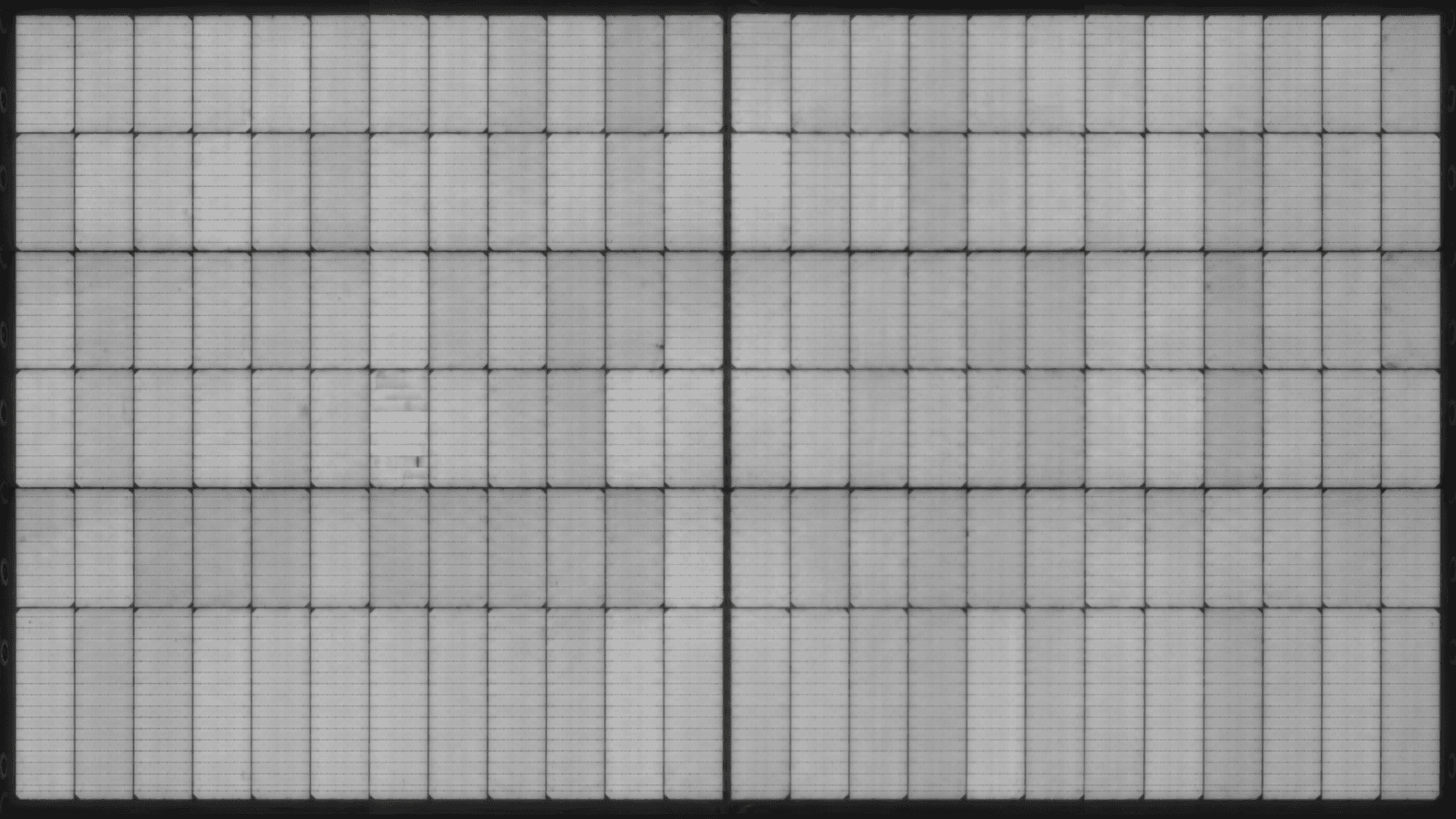
Inspection pipeline
One image. Several precise steps.
Each stage builds on the last. The result is a classified finding at cell level, evaluated against your configured criteria.
Factory preparation
Adapted to the conditions of your factory.
The model is prepared using production images from your inspection station, under your imaging conditions, and evaluated against your defined defect categories before deployment.
—Production inference and model training are separate processes.
—Defining a new defect class and training the model to detect it require separate steps.
01
Production data review
Representative EL images from the inspection station are reviewed. Image quality, capture conditions and panel layout are assessed before labeling or training begins.
02
Defect definition and labeling
Defect categories are agreed with the quality team and labeled in the production images. Defining a class in the interface and training the model to detect it are separate steps — both are required.
03
Model preparation
The model is trained on the labeled production data under the agreed defect definitions. This takes place in a controlled environment separate from production inference.
04
Held-out validation
A set of labeled images not used during training is used to assess detection quality before any station testing begins.
05
Station evaluation
The prepared model is evaluated at the inspection station under real imaging conditions. Findings are compared against operator decisions and quality team reference assessments.
06
Deployment within the agreed scope
Deployment covers the validated defect classes, agreed criteria and the configured operating mode. Changes to imaging conditions, panel layout or quality criteria may require reassessment.
Operator decisions that diverge from expected results require reference assessment by the quality team before criteria are adjusted.
Local architecture
Inference stays close to the line.
The PVExa process runs at the inspection station. Image data is read locally; results are returned to the existing workflow.
Reads (monitor only)
Returns result to EL workflow
Existing control chain
Integration is assessed against the station software, image access and existing decision workflow.
PVExa components
PVExa CellNet
Cell-level model family
PVExa GridMap
Cell mapping and coordinate generation
PVX Inference Runtime
Local model execution
PVExa LineBridge
Connection to the existing EL workflow
Quality and performance
Measure the model. Verify the workflow.
Inspection quality
Precision
How often a predicted defect is confirmed.
Recall
How many reference defects are detected.
False accepts
Defective panels incorrectly accepted.
False rejects
Acceptable panels incorrectly rejected.
Operator agreement
How often AI and operator decisions match.
Operational performance
Inference latency
Time spent running the model.
End-to-end decision time
Time from image availability to result delivery.
Operator review requirements
When human review is part of the workflow.
Impact on station cycle
How inspection affects the station's overall timing.
270
MS
End-to-end in the documented station setup.
Timing depends on hardware and station conditions. Inference time and total line cycle time are separate measurements.
Data and operations
Boundaries, not black boxes.
Let's map your
inspection setup.
Discuss your EL software, imaging conditions and quality workflow with our team.
Discuss your integrationExplore PVExa Inspect →