Cell-level inspection
Anomalies are localised at sub-millimetre resolution — not limited to cell or string boundaries.
Factory-specific quality criteria
Decision thresholds are configured against your own process data, not generic industry benchmarks.
Local inference
All AI processing runs on-premise. No image data leaves your facility.
Existing EL workflow integration
PVExa connects to your current EL camera and acquisition setup without replacing equipment.
How the AI sees your panels
From raw image to verdict.
Every EL frame passes through three stages in under 300 ms. Click each stage to see what the model extracts.
Stage 1 of 3
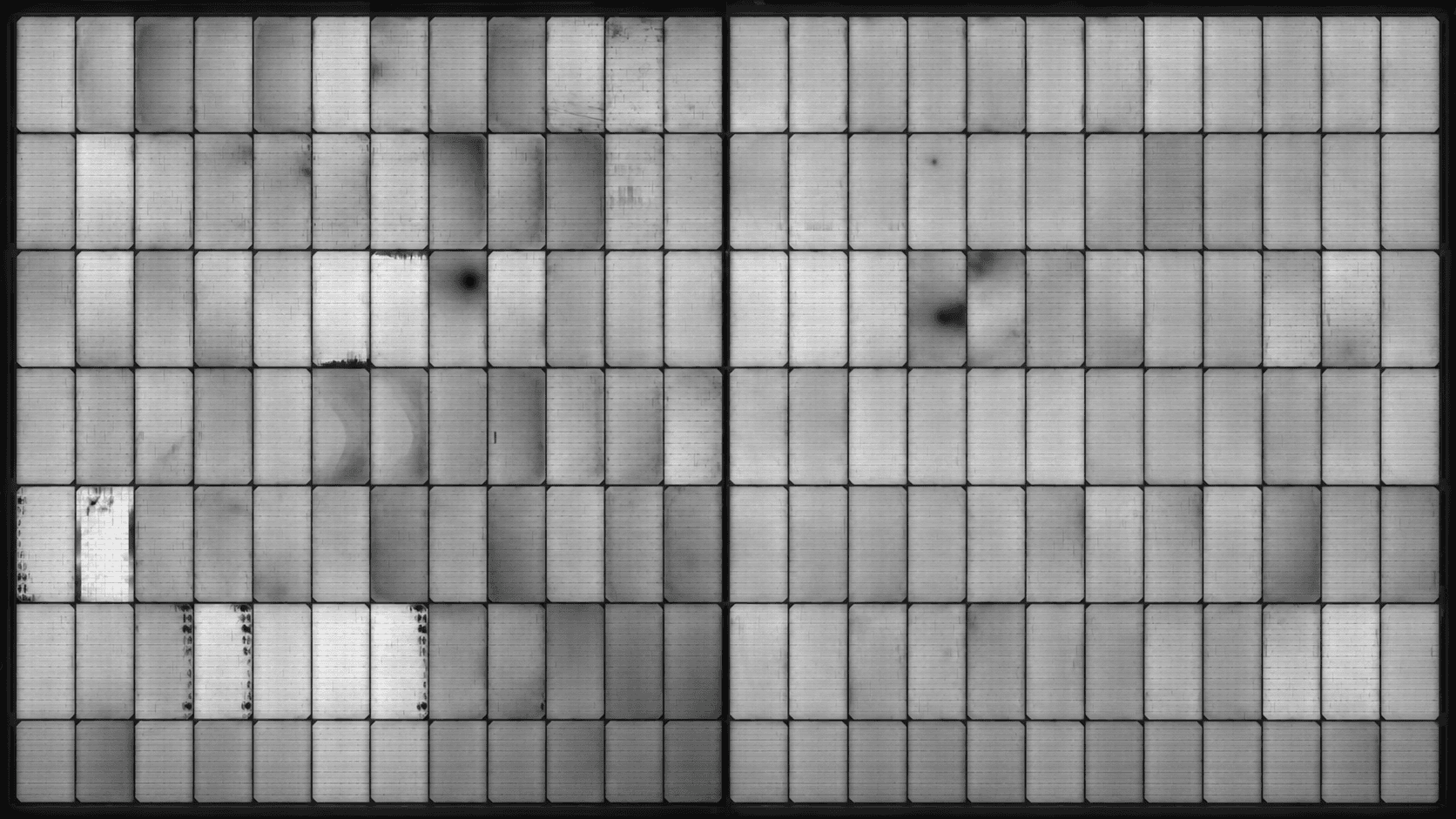
Raw electroluminescence image captured by the inline camera. Each panel generates a high-resolution grayscale frame during the EL flash window — the source material for all subsequent analysis.
AI inference~270 ms per frame (on-device)
Inspection scopeCell-level — sub-millimetre resolution
Defect typesCracks, dark areas, busbar anomalies
Factory-trained intelligence
One model per factory. Not one model for all.
A model trained on factory A's paste, cells, and laminator profile sees things a generic model misses — and avoids the false alarms that erode operator trust.
Calibrated per line
Thresholds are set against your own historical scrap data, not industry averages.
Adapted to your production data
The model is updated from your verified frames when your process changes — not retrained from generic datasets.
Auditable decisions
Every verdict stores the raw confidence score and the pixel region that triggered it.
Integration
Deployment planned around your production workflow.
PVExa connects to your existing EL camera and acquisition setup. The first-pass model is trained on your archive data while the line keeps running.
01
Camera connection
We connect to your existing GigE Vision or Camera Link camera. No new hardware required.
02
Model training
First-pass model trained on your archive EL frames against your factory-specific quality criteria.
03
System integration
Verdict signals are wired to your line control system via standard industrial interfaces.
04
Go live
Operators see OK / NG on the existing display. PVExa runs in the background without disrupting the line.
Performance
270 ms where manual inspection takes 10–30 s.
Common questions
Before you talk to our team.
2-week pilot
Prove it in
your factory.
We start with your EL frames and your quality criteria. The evaluation runs on your line, assessed by your QA team.
—Labelled EL frames from your specific line
—Model trained against your factory quality criteria
—Live evaluation with your QA team
—Report: detection coverage and false-alarm rate